
Heritage Health Index (HHI)
A joint-initiative between Heritage Preservation and the Institute of Museum and Library Services (IMLS) created the Heritage Health Index. A comprehensive survey, conducted in 2004 and published in December 2005, formed the first comprehensive record of the current conditions and preservation needs of America's collections. The first HHI found that immediate action was needed to prevent the loss of millions of irreplaceable artifacts.
A Proud--and Practical--Preservation Legacy
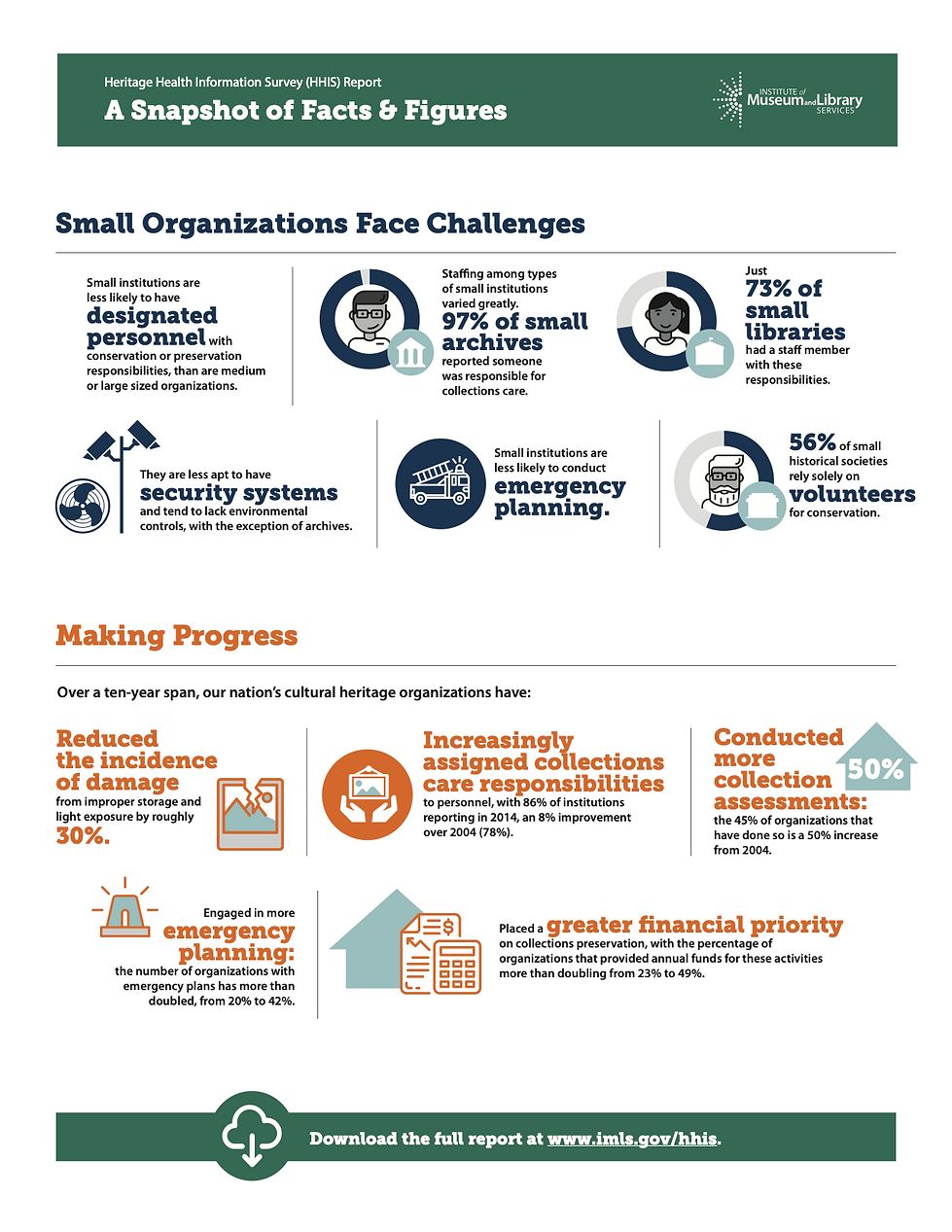
The 2004 Heritage Health Index and the 2014 Heritage Health Information Survey
Essay by Margaret Holben Ellis, former Board President of the
American Institute for Conservation
Under the champion spirit of its President, Lawrence Reger, Heritage Preservation developed a reputation for identifying and spotlighting risks to American heritage collections and quickly responding to them with targeted and innovative collection care programming. Heritage Preservation’s enduring commitment to the condition and care of collections, has emerged as its proud – and practical – legacy as a result of two ambitious campaigns: the 2004 Heritage Health Index and the 2014 Heritage Health Information Survey. Designed to quantitatively assess and, a decade later, to measure progress in collection care, these documents have become indispensible references for those responsible for preserving billions of artifacts in more than 30,000 archives, libraries, museums, historical societies, scientific research institutions and archaeological repositories across the United States and its territories...
"One of the most alarming Heritage Health Index statistics is that 80% of collecting institutions do not have an emergency or disaster plan that includes collections, with staff trained to carry it out.
Because of this, more than 2.6 billion items are at risk."
In August 2004, the Heritage Health Index survey was distributed to more than 14,500 archives, libraries, historical societies, museums, archaeological repositories, and scientific research collections, which included institutions of all sizes from every U.S. state and territory.
The Heritage Health Index asked institutions to report on all aspects of conservation and preservation and to estimate the quantity and condition of the collections for which they have a preservation responsibility.
Based on the findings of the Heritage Health Index, Heritage Preservation recommended that:
-
Institutions must give priority to providing safe conditions for the collections they hold in trust
-
Every collecting institution must develop an emergency plan to protect its collections and train staff to carry it out
-
Every institution must assign responsibility for caring for collections to members of its staff
-
Individuals at all levels of government and in the private sector must assume responsibility for providing the support that will allow these collections to survive
A summary of the Heritage Health Index results has been published in A Public Trust at Risk: The Heritage Health Index Report on the State of America’s Collections can be found below.

HHI in the Media
All Things Considered - U.S. Museum Collections in Dire Condition
December 12, 2005. https://www.npr.org/templates/story/story.php?storyId=5049523

A Public Trust at Risk: Findings of the Heritage Health Index. 2007. Video. https://www.loc.gov/item/webcast-5252/.
Lynette Clemetson, History Is Slipping Away as Collections Deteriorate, Report Says. The New York Times. December 6, 2005. https://www.nytimes.com/2005/12/06/arts/history-is-slipping-away-as-collections-deteriorate-report-says.html
Funding
.png)
"The Heritage Health Index was an ambitious project from its start. It was announced in Spring 2001, and the final report was published in 2005. I particularly remember the release of the report because we held a rare press event in New York City at the New York Public Library to announce the summary report, which was designed by a professional designer and looked beautiful.
But we had to finish the full report before the press conference, which I believe was in early December 2005. So Kristin Overbeck Laise, the project manager, and I worked on it over the Thanksgiving break. She would email me chapters and graphs, and I would drop them into the layout and proofread. I remember it was Thanksgiving because I was printing the pages to proof, and my printer died. So I ended up at CompUSA on Black Friday!
But we got it finished, all 180-something pages of it. It was the first of its kind and represented so much work, not only by Heritage Preservation, but by all the institutions that participated. It was worth giving up the holiday!"
Diane Mossholder